Blink
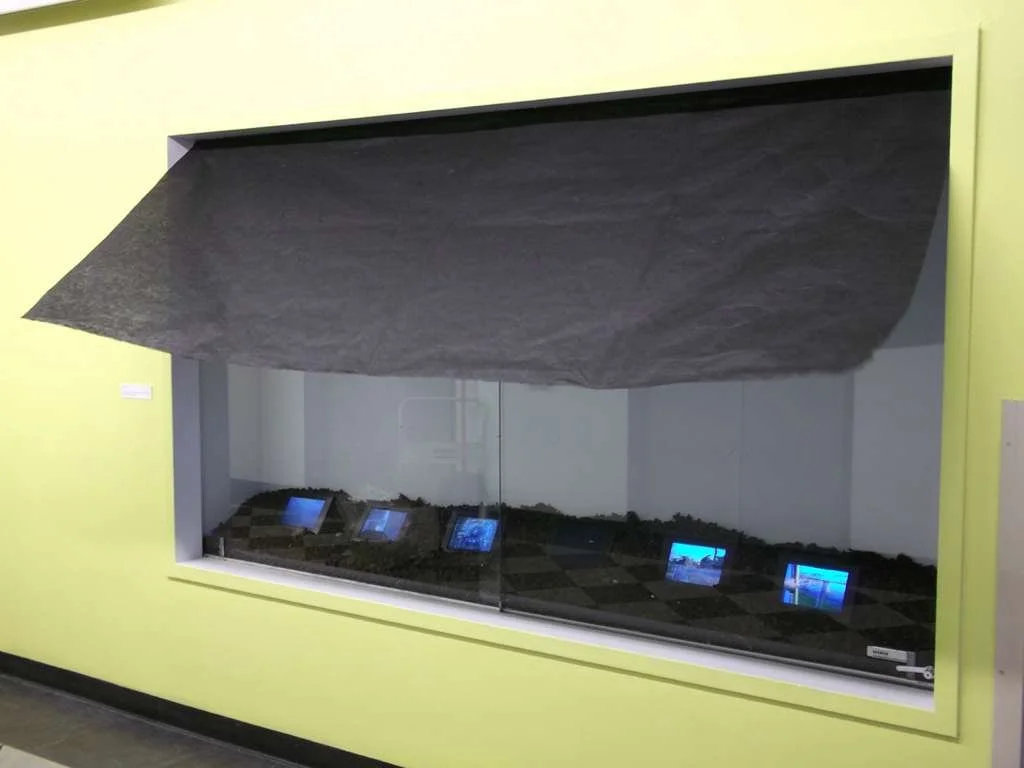
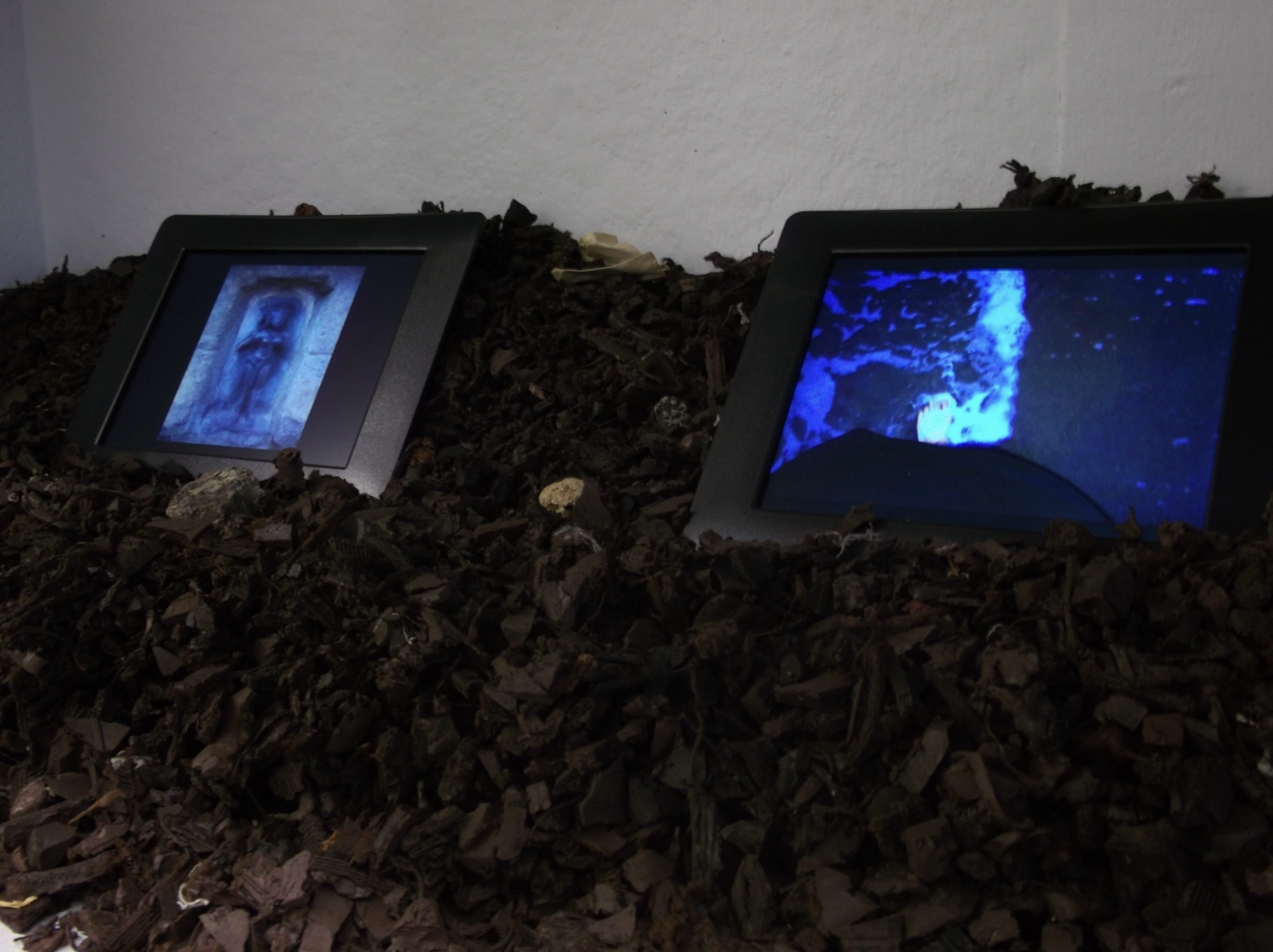
installation with five stop motion films, rice paper, and mulch, sand, rock, and debris gathered from Mount Kailash in Tibet and exhibited at the School of the Art Institute of Chicago, Chicago, IL, 2012
Blink is an installation set not in a gallery, but within the everyday passageways of the School of the Art Institute of Chicago—a work encountered in motion, on the way to somewhere else.
A section of wall is cut open, hollowed into a shallow chamber and filled with mulch, sand, rock, and debris gathered from Mount Kailash in Tibet and the Meenakshi Temple in South India. The materials carrying traces of movement, offering, and passage. Embedded within this cavity are five small monitors. Each holds a different stop-motion video, recorded during walks in Tibet and India. All run simultaneously. Movements layer and overlap, briefly visible, then erased. What is seen is partial. Attention arrives late, or only in fragments.
Sheets of handmade black paper are attached to the top of the exterior glass covering the inset. The paper hovers, moving in and out with air currents created by passing bodies, elevators opening and closing, the building breathing. As it shifts, it intermittently obscures the screens, breaking the walks into flickers and pauses. Images appear and vanish. Motion collapses into stop-motion. Seeing becomes conditional.
The work asks for no sustained viewing. Attention is neither required nor measured. Blink exists in the periphery, activated by chance: by airflow, by footsteps, by the inattentive glance that briefly steadies. It considers how attention behaves outside the protected space of the gallery—how perception can be interrupted, incomplete, and still alive. A wall becomes a membrane. Walking becomes an image. Looking becomes something that happens in passing, then disappears.